


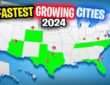



America’s growth map is currently dominated by the “suburban-metropolitan” hybrid. As of 2026, the fastest growing US cities by percentage are often smaller satellite cities that offer proximity to major hubs but with lower price tags. Princeton, Texas, has recently topped growth charts with a staggering 30% annual population increase. Other leaders include:
The fastest growing US cities in recent years are dominated by Sun Belt metros – led by cities like Georgetown, TX; Leander, TX; Cape Coral, FL; Buckeye, AZ; and Frisco, TX – cities that are largely suburban or exurban, affordable relative to coastal metros, and located in states with no income tax.
Top 15 Fastest Growing US Cities (by % population growth)
|
Rank |
City |
State |
Growth Rate |
Key Driver |
|---|---|---|---|---|
|
1 |
Georgetown |
Texas |
~15-20% |
Austin metro spillover |
|
2 |
Leander |
Texas |
~14-18% |
Austin affordability overflow |
|
3 |
Buckeye |
Arizona |
~12-16% |
Phoenix metro expansion |
|
4 |
New Braunfels |
Texas |
~10-14% |
San Antonio/Austin corridor |
|
5 |
Frisco |
Texas |
~10-13% |
Dallas-Fort Worth corporate boom |
|
6 |
Cape Coral |
Florida |
~9-12% |
Florida migration surge |
|
7 |
St. George |
Utah |
~8-11% |
Outdoor lifestyle + affordability |
|
8 |
Greenville |
South Carolina |
~7-10% |
Manufacturing + remote work |
|
9 |
Boise |
Idaho |
~7-9% |
Tech migration from California |
|
10 |
Sarasota |
Florida |
~6-9% |
Retiree + remote worker combo |
|
11 |
Raleigh |
North Carolina |
~5-8% |
Research Triangle job growth |
|
12 |
Nashville |
Tennessee |
~5-7% |
No income tax + culture |
|
13 |
Jacksonville |
Florida |
~4-7% |
Finance sector growth |
|
14 |
Huntsville |
Alabama |
~4-6% |
Defense and aerospace |
|
15 |
Austin |
Texas |
~4-6% |
Tech hub anchor |
*Note: Growth rates are approximate based on recent Census data and vary by exact measurement period.*
The Five Cities Worth Understanding in Depth

Georgetown, Texas
A small city north of Austin that has become one of the fastest-growing in the country purely because Austin became too expensive. Georgetown offers the Austin lifestyle adjacency – tech jobs within commuting distance, Hill Country aesthetics – at prices that were genuinely affordable until recently.
Buckeye, Arizona
Phoenix’s westward expansion has reached Buckeye, which was effectively desert a decade ago. Large master-planned communities, proximity to Phoenix employers, and Arizona’s warm climate drive relentless growth.
Frisco, Texas
The corporate headquarters relocation wave has directly fed Frisco. Companies like Toyota, Liberty Mutual, and dozens of others have moved regional or national HQs to the Dallas-Fort Worth metroplex. Frisco captures that growth at the residential level.
Greenville, South Carolina
One of the more interesting growth stories – a mid-size Southern city that has successfully attracted manufacturing (BMW, Michelin), positioned itself for remote workers, and developed a genuinely appealing downtown. Growing without the Texas heat and hype.
Huntsville, Alabama
Space and defense spending has transformed Huntsville. NASA’s Marshall Space Flight Center, the Army’s Redstone Arsenal, and a growing private aerospace sector have turned this city into one of the most educated and economically dynamic mid-size cities in the South.
What’s Driving All of This?
Four converging forces explain the Sun Belt growth wave:
|
Factor |
How It Drives Growth |
|---|---|
|
Remote work |
Workers freed from office locations chose affordable cities |
|
Corporate relocation |
Companies followed workers – and followed low-tax states |
|
No state income tax |
Texas, Florida, Nevada, Tennessee attract both businesses and residents |
|
Housing affordability (relative) |
Coastal transplants find Sun Belt prices relatively affordable |
The Catch: Growing Pains
Fast growth creates real problems. The cities at the top of these lists are now dealing with:
- Traffic infrastructure that was built for a fraction of current populations
- Housing affordability deteriorating as demand outpaces supply
- School overcrowding and infrastructure strain
- Water scarcity (particularly acute in Arizona and Texas)
The cities that manage this growth well will cement their status. Those that don’t will see the migration wave pass them by for the next affordable alternative.
Bottom Line
The fastest growing US cities share a profile: Sun Belt location, low or no state income tax, relative affordability, and proximity to job markets. Georgetown and Leander are growing because Austin got expensive. Buckeye is growing because Phoenix got expensive. The pattern repeats. Understanding this growth isn’t just demographic trivia – it’s a map of where economic opportunity and quality of life are intersecting right now.

How to Transform Your Business Growth with Vastu for Factory Solutions?
In today's competitive industrial landscape, business owners are constantly searching for ways to improve productivity, profitability, and workplace harmony. While...

Investopedia Stock Simulator: The Best Free Tool for Learning to Invest

The Investopedia Stock Simulator is a free virtual trading platform that gives you $100,000 in "paper money" to trade real...

What Is a Credit Score? Everything You Need to Know


A credit score is a three-digit number—typically ranging from 300 to 850—that represents your creditworthiness based on your borrowing and...

How to Calculate Debt to Equity Ratio: Step-by-Step Guide
The how to calculate debt to equity ratio process takes less than a minute once you have a company's balance...